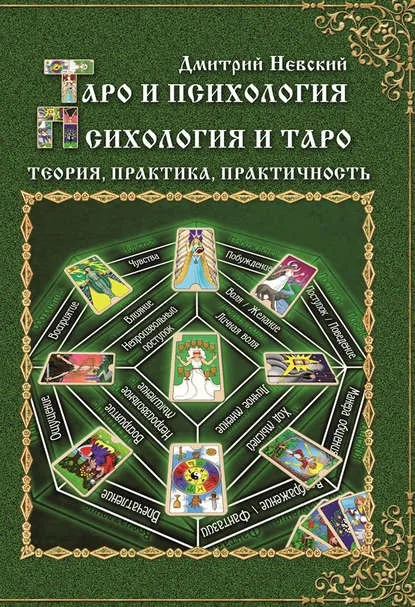
Tarot and Psychology. Psychology and Tarot. Theory, Practice, Practicality – Dmitry Nevsky
Delivery across Bulgaria with Econt — you pay on delivery. The shipping price is shown in the cart.
The book by Dm. Nevsky – in Russian
Excerpt:
Introduction
Tarot and psychology? What connection could there possibly be between them? On one side – psychology, an officially recognised science that gained that status in the 19th century, with ancient roots stretching back to the time of Hippocrates, Plato, and Aristotle (300–400 BC). On the other – Tarot, which was officially and publicly acknowledged in the 19th century (a coincidence?), though its unofficial history of recognition traces back to the 1st century BC, when criteria and forms that later became part of the structure of Tarot were first mentioned. It follows that the age of origin, as well as the presence or absence of public recognition, cannot serve as an argument for accepting or rejecting any given point of view expressed in the form of a particular concept.
So what will help us understand and correctly assess the compatibility or incompatibility of Tarot and psychology? What can we rely on when comparing things that are not so easy to compare?
Norms and Measures
Any science, any philosophical or esoteric worldview, is first and foremost a perspective on a process, a situation, a form. It sets a certain range of questions and answers those questions according to its own foundation as it exists at any given moment in time. What questions does Psychology ask of itself, and what questions does Tarot ask of itself? Let us try to answer impartially.
Psychology is a science that studies structures and processes inaccessible to external observation, with the aim of explaining the behaviour of humans and animals, and the psychological characteristics of individuals ....