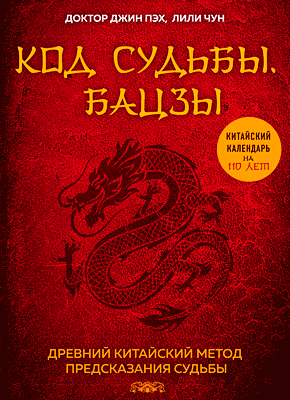
The Destiny Code: BaZi – Ancient Chinese Fortune-Telling Method
Delivery across Bulgaria with Econt — you pay on delivery. The shipping price is shown in the cart.
Author: Pah J., Chun L.
Illustrations: black-and-white
Total pages: 606
Binding: softcover
Language: Russian
Size: 14.5 × 20 cm
The Four Pillars of Destiny, also known as Zi Ping Ba Zi or the Eight Characters of Birth, are believed to have originated during the Tang Dynasty and flourished under the Song, Yuan, Ming, and Qing dynasties. Since ancient times, the Thousand-Year Calendar has been used in China as the primary tool for calculating the Four Pillars of Destiny. From the founding of the Republic of China in 1911, the Four Pillars method of destiny analysis spread throughout Southeast Asia through the work of Chinese metaphysics masters. From 1984 onwards, masters from Hong Kong, Malaysia, and Singapore began introducing this method of destiny analysis to the West. For more than twenty years, Western books on the Four Pillars have been sold in the markets of the United Kingdom and North America. Although these books have not fully managed to explain the ambiguous methods required for careful chart interpretation, their growing sales leave no doubt that the subject has become enormously popular among readers. When the book The Road to a Happy Destiny appeared in 1997, English-speaking readers gained the opportunity for the first time to use the Thousand-Year Calendar to construct their own Four Pillars charts and life cycles. In addition to introducing readers to the concept and structure of the Four Pillars, the book offers a calendar that uses the alphabet to represent the Heavenly Stems and Earthly Branches. In this way, readers can determine which of the five elements is favourable for them. Using this information, they are able to recognise auspicious and inauspicious days as well as their life cycles.
Today the Four Pillars have become a global phenomenon, spreading through conferences, courses, and training programmes dedicated to them. Websites and social media groups, as well as applications that allow you to calculate individual Four Pillars charts online, all attest to the popularity of the teaching. With such an abundance of material in both English and Chinese, you may wonder: why do we need yet another book on this doctrine? Let us explain.
Many books on the Four Pillars focus on obscure texts without offering any explanation of how the reader might apply the information. Readers are left to guess at the meaning of the messages encoded in the charts. At times it can even feel as though one is trying to solve a riddle that has no clear answer. More dedicated readers may spend a considerable amount of time studying ancient texts and still find themselves lacking a degree of confidence in correctly identifying the useful elements within a chart. This book is intended primarily to teach readers how to interpret Four Pillars charts through clear and concise examples.