The Autumn House: What Is It Time to Let Go Of?
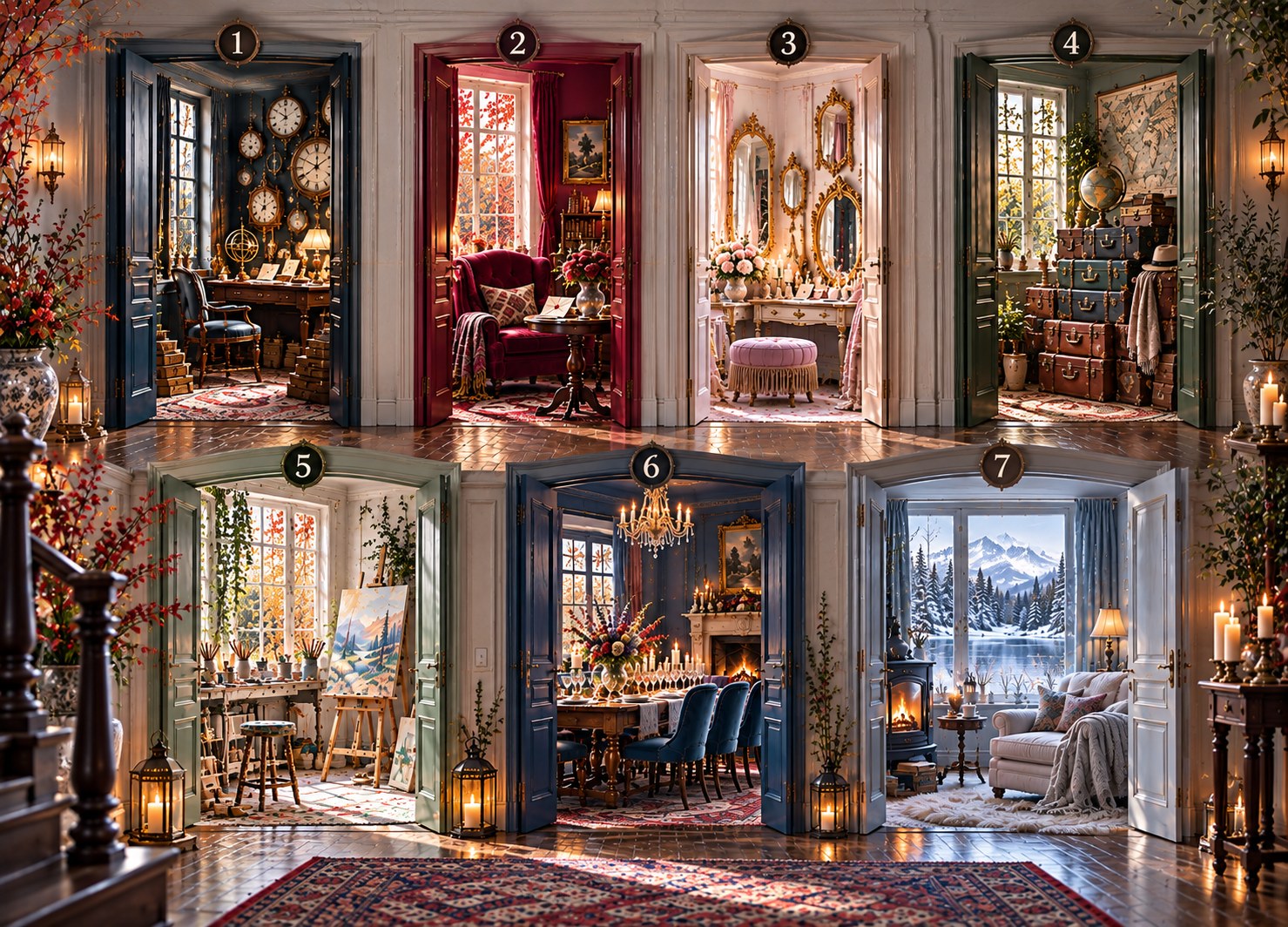
Seven rooms, a cup of tea and one hour just for you. Choose the room you enter and the one you walk past.
You go out for bread and on the way you decide to cut through the park. A few tasks are waiting for you at home, your phone has already reminded you that it exists, and you promise yourself just ten minutes of walking. Then you step onto a pile of dry leaves, and that crunch under your shoes brings you back to a pleasure you had completely forgotten about. You nudge a few more with your foot, just to check whether you can still do it. Of course you can. You glance around to see whether anyone noticed and carry on a little more slowly.
On the next path you notice a house behind a low fence. You must have walked past here before, but today, for the first time, you see how beautifully autumn has wrapped itself around its windows. Leaves have gathered on the steps, and the front door stands ajar. From inside comes the chime of porcelain, and a woman appears in the doorway with a cup in her hand. “Come in if you’re cold. I’ve just made tea,” she says, with the ease of someone who has time to spare and is ready to give you a little of it.
This is probably where you’ll ask me how on earth you are supposed to walk into a stranger’s house for the sake of a cup of tea. A fair question. For this walk, though, we can allow ourselves a little imagination and see what is waiting for us behind the door. The bread can wait for now.
Inside it smells of wood, freshly brewed tea and a cake that has just come out of the oven. You take off your coat and for a moment you remain standing, as if you were expecting to be asked to help with something. The woman simply points down the corridor: “Choose wherever you feel at ease. I’ll bring the cups.” It sounds so simple, and yet you catch yourself realising that it has been a long time since anyone asked you where you feel at ease.
Seven rooms open up before you. In one of them, clocks measure out the time above a desk with an open notebook. In another, two cups have been left beside the letters. Further along, mirrors glimmer, suitcases wait beside one of the doors, and in a bright room an unfinished painting still seems to hold the movement of the brush. You also see a table laid for guests and a comfortable armchair by a window overlooking the lake. Your gaze drifts of its own accord towards one of these places.
Which room would you stay in for an hour? Look at the image and imagine that you are already stepping inside. What would you do first? Would you sit down by the window, look through the letters, step closer to the canvas? Give yourself a little time to sense what draws you. Here you can choose according to your own wishes, without having to consider where it would be most convenient for everyone else.
Then look again and choose which room you would walk past the most quickly. Perhaps some object reminds you of something, perhaps you feel a certain tension, or perhaps you simply prefer a different atmosphere. Notice what exactly makes you carry on down the corridor.
Write down the two numbers like this: “I enter… / I walk past…” For example: “I enter 5, I walk past 2”. Then read the messages and see which parts of them find a place in your own story. This is a symbolic walk for self-reflection, in which your own memories and associations are part of the experience.
And now choose a room. The tea is on its way, your tasks know perfectly well how to find you without directions, and this one hour you can keep for yourself.
Tap the door of the room where you would stay for an hour.
What the seven rooms keep
First read the message of the room you chose to enter. Look for a connection with what you are going through right now. Then open the interpretation of the room you walked past and ask yourself which detail pushed you away. The matches can suggest a theme for reflection, and the mismatches can help you name your own feeling more precisely.
1. The Room with the Clocks — when calm depends on you
Picture two friends having coffee on a Monday morning. One of them explains contentedly that she finally managed to get some rest over the weekend. The other asks her what she did, and a whole list begins: she did the shopping, cooked for three days, booked her mother in for a check-up and fixed a mistake in the work rota, because “otherwise Monday would have been a disaster”. In the meantime she found a hotel for the family trip and changed the burnt-out bulb in the hallway. “And when do you actually rest?” her friend asks. The answer comes with genuine surprise: “Well, I did all of that in peace, nobody was interrupting me.”
If you smiled with a certain awkwardness, you probably recognise this idea of rest. You enter the room with the clocks and immediately notice how conveniently it is arranged. The desk is spacious, the notebook is open, and everything has its place. Here you can easily sit down, make a list and feel relief when everything that lies ahead finally fits into a few lines. After your own tasks, though, a few more usually appear — reminding someone about the check-up, checking the booking, asking whether the documents are ready. You are probably the person around whom everyone else can afford to be pleasantly absent-minded.
This ability has surely helped you a great deal. Perhaps you have long relied mainly on yourself, or you have lived through enough situations in which someone made a promise and then you were the one left gathering up the consequences. It is understandable to want to be prepared. When you know what lies ahead, you breathe more easily. Gradually, though, the preparation may have spread to things over which you have very limited influence — other people’s decisions, the moods of those close to you, the course of a conversation that has not even taken place yet. You have supposedly sat down with a coffee, yet in your head an operations centre is already in session, discussing three possible crises before lunch.
Do you know the moment when someone tells you “Leave it, I’ll do it”, and you feel glad and at the same time start explaining exactly how it should be done? Then you check whether they have started, remind them of one small detail and in the end finish it yourself, because by now that is easier for you. In the evening you are tired and, quite reasonably, you wonder why everything has once again been left to you. How do you cope with the time between the other person’s promise and the finished result? What do you imagine will go wrong while you are waiting? Sometimes it is precisely these few hours of uncertainty that push us to take on work we could easily have shared.
If you chose this room, think about the last time everything necessary had been done and you still kept looking for something else to fix. Do you manage to feel satisfied, or does your gaze immediately find the next oversight? There will always be one more task turning up. The question is whether you allow yourself to decide on your own when you have done enough for today, instead of waiting for the whole world to be put into decent order.
Try it with a small shared task and with a person you have good reason to trust. Let them choose the place for dinner or organise part of the trip. Agree on what is needed and give them time to finish. You will probably be tempted to send a “just checking”. Before you do, finish your coffee and notice what is happening inside you. The other person may approach it differently, miss a detail that matters to you, or handle it wonderfully in a way you had never even thought of. In this way you will gradually find out where you can share the responsibility and where your involvement is genuinely needed.
If you walked past the room with the clocks, go back to your first impression. Perhaps the desk reminded you of work that follows you everywhere, and the clocks of the feeling that you are constantly running late for someone else’s expectations. It is possible that you already guard your time deliberately, and this setting looks to you like an invitation to take on even more obligations. What exactly made you stay outside? Trust your own association, even if it is simply the wish that in at least one room nobody is keeping an eye on the time.
Before you carry on down the corridor, imagine that you can leave on the desk one of the worries you constantly take along with you. The clocks will keep on ticking, and you will have a free afternoon. What would you leave in this room, and what are you afraid will happen while you are away? The answer may show you why, even when you sit down to rest, a part of you remains on duty.
If you would like to continue this reflection, open the “Letting Go” room on FatedWays and take this question with you: “Which responsibility do I keep carrying alone because I find it hard to trust, and what small part of it could I share?” To begin with, choose something that you can genuinely leave in other hands. The family dinner will probably survive a restaurant you have not personally checked.
2. The Room with the Letters — the waiting
The woman at the next table turned her phone face down, opened the menu and half a minute later looked at it again. Her friend was still choosing what to order when the phone rang. She snatched it up so quickly that her teaspoon fell to the floor. The message was from a courier. The parcel would arrive between two and five — an enviable precision compared with the person whose call she had been waiting for for three months now. “There may be a reason they’re staying silent,” she said, and put the phone down next to her cup, this time face up.
Has it ever happened to you that your day seems to be going along normally, yet somewhere in it there is a constant “maybe today”? You work, meet people, laugh at something, and then, quite naturally, check whether there is a message. Gradually you begin to measure time by someone’s absence. A week has passed since your last conversation, a month since the promise to talk, a whole season since that “I’ll explain”. Meanwhile you have come up with several possible explanations and conducted the conversations from both sides. Quite a lot of work for someone who is not even taking part.
In the room with the letters there is space for exactly this kind of waiting. The armchair is comfortable, there are two cups, and the envelopes left on the table hint that someone still has something to say. If this room drew you in, ask yourself whom or what you pictured in it. Sometimes we are waiting for a loved one to come back. At other times we want an apology from a friend, recognition from a parent, or a few honest words from someone who left and let us puzzle out the ending on our own. We may well have carried on with our lives and still feel an unfinished conversation intruding into the present.
What would you like to hear if the armchair opposite were suddenly taken? “You mattered to me”? “I behaved badly”? “I understand why it hurt you”? Name the words as precisely as you can. They can show you what you are still looking for in that answer — confirmation that what you lived through was shared, that your trust was well founded, that someone sees the consequences of their actions. It is entirely human to want a conversation like this. The difficulty begins when you postpone your own decisions until the other person finds the will to have it.
Sometimes behind the waiting lies a whole life that you had already begun to imagine. You know where you would have travelled, how your Sundays would have gone, what would happen “when everything calms down”. Parting with these pictures also takes time. You may miss the person, and you may also be grieving for the woman you were beside them — braver, more in love, full of anticipation. Which of these feelings would you like to find a place in your days once again? What did this encounter awaken in you that you still want to live through?
Take a sheet of paper and write a letter that, for now, will stay with you. Describe what happened as you see it, what you miss and what you are angry about. Allow yourself to be candid, including in the places where your feelings contradict each other. You can grieve for someone and at the same time know that their return would hurt you all over again. Towards the end, write down what you are still putting off because of this story — a trip, a new acquaintance, a decision of your own, the right to feel good. Choose one of them and think about how to give it a concrete place in the coming days.
If you preferred to walk past this room, notice what made you draw back. The letters may have stirred a memory that is hard for you to approach today. The two cups may have reminded you of how long you kept a place for someone. It is also possible that this silence already feels foreign to you, because you have finished with that kind of waiting and want to be among people who are present in your life. Let your own feeling guide you.
Before you leave the letters on the table, look at the empty armchair and ask yourself: “If I knew that the person I am waiting for will never walk into this room, how much more of my life would I spend here, and what would I wish to find waiting for me outside?” Give yourself time for the answer. You might feel like meeting a friend, taking a trip you have long been putting off, or spending an evening without checking your phone at every notification.
If you sense that this conversation is still going on inside you, you can visit the “Letting Go” room on FatedWays. Go in with the question: “What do I still expect from this person, and what am I putting off in my own life while I wait?” Perhaps you already know where you want to begin, but until now you have been keeping your free hour for someone else’s call.
3. The Room with the Mirrors — other people’s eyes
The woman came out of the fitting room in a red dress and, for the first time since she had walked into the shop, smiled at her reflection. She turned sideways, smoothed the fabric and even took a few steps to see how the skirt moved. Then she picked up her phone and sent a photo to two friends. One asked what occasion she was buying it for, and the other remarked that black is always more elegant. The woman looked in the mirror again. The dress was exactly the same, yet she was already tugging the neckline upwards. “Maybe it’s a bit too much for me,” she told the shop assistant, and went back into the fitting room. In ten minutes she had collected two opinions and lost her own.
Do you recognise that small step back from something you liked only a moment ago? You have already decided, then someone raises an eyebrow and you start reconsidering. Whether the colour suits you, whether the idea is sensible, whether you will look ridiculous, whether people will think something. People, of course, rarely miss an opportunity like that. The question is how many of their thoughts you settle into your own head in advance.
The room with the mirrors is beautiful precisely because it offers so many points of view. In one mirror you look confident, while in another you notice only what you would fix. You move closer, step back, search for the right angle. If this room drew you in, think about whose presence you sensed beside you. Whose voice can most easily change the way you see yourself? Sometimes it is a person you talk to every day. At other times it is a remark made so long ago that whoever said it has probably forgotten it. You, however, still take it with you when you choose a dress, speak in front of people or dare to ask for more.
Perhaps you were praised when you were modest, sensible and accommodating. You learned what goes down well and became very good at judging it. You sense when to smile, when to stay silent, when to present your wish so that it sounds acceptable enough. This skill helps in relationships, but sometimes you start using it even where the choice is entirely yours. You buy something for yourself and are already preparing its defence before an imaginary family council. The meeting has not even begun, and you have voluntarily cut the budget and changed the colour.
How do you know whether you are really seeking advice or waiting for permission? Remember the last opinion you asked for. Did you want to learn something useful, or were you hoping someone would confirm that you had the right to want exactly that? And when the answer differed from your taste, were you able to leave it as simply a different point of view? Other people’s experience can be valuable to you. It is just as valuable to sense where its relevance to your own life ends.
The most interesting part begins when you ask yourself what you would choose without an audience. You may discover that you like bolder clothes, that you prefer a quiet holiday to a prestigious trip, or that the job everyone admires has been wearing you out for a long time. Your wishes may well be entirely ordinary. Sometimes our own preference is hard to hear simply because we are used to immediately accompanying it with the question “And how will this look?”.
Give yourself a small experiment over the next few days. Choose something to your own taste and wait before putting it up for discussion. Wear the outfit, stay with the decision, see how you feel in it. If someone comments on it, you can answer quite calmly: “I like it.” Notice how comfortable it is for you to end the sentence right there. You may feel the urge to add three reasons, one concession and a promise to be more practical next time. Smile at this habit and leave yourself the chance to try something different.
If you walked past the room with the mirrors, what wore you out already at the threshold? Too much looking at yourself, the feeling of being on display, or the thought that you would once again find something to fix? Perhaps right now you long to turn your attention to the experience itself, rather than to the way you look in it. It is also possible that you have already built a calmer relationship with yourself and this room simply does not stop you. Follow your reaction without forcing it to fit a ready-made answer.
Before you leave, stand in your mind in front of one of the mirrors and imagine that all the people whose approval you usually seek have withdrawn from the room. What do you like about the woman facing you, and what choice would she make if today she trusted her own eyes? Notice, too, what you find hard to admit with pleasure — beauty, ambition, sensuality, a wish to be noticed. Which of these do you still accompany with an apology?
To continue with this theme, you can open the “Gifts” room on FatedWays with the question: “Which quality of mine do I play down while I wait for others to acknowledge it, and how could I give it more space in my life?” Think of a specific occasion when you showed this quality. Keep it as your own observation — something you know about yourself, even when there is temporarily no applause around you.
4. The Room with the Suitcases — someone else’s load
At the airport, a woman opened her suitcase in front of the check-in desk because the scales stubbornly showed four kilos too many. She took out a thick jumper, two jars, a hardback book and a pair of men’s shoes. Her friend watched the growing pile and finally asked: “What did you actually bring for yourself?” The woman thought for a moment, then lifted a single blouse from the bottom. The rest was “take this to my sister”, “you’ll surely have room for it” and “it hardly weighs anything”. The last one was obviously a particularly popular opinion among the people who had no intention of carrying the suitcase.
Sometimes our week fills up in just the same way. Someone needs you to stand in for them, another is counting on you to drive something over, a third entrusts you with a task because you are more capable. Each request on its own seems doable. Put together, they take up your free day, your evenings and those two hours you were supposedly going to set aside for yourself. When you finally say you are tired, you even find it hard to explain what exactly from. After all, they are all just small things.
In the room with the suitcases, it is worth looking closely at the labels. What is genuinely your obligation? What have you agreed to share? What did you take on for a short while, after which the arrangement somehow forgot to end? If this room drew you in, perhaps you know the peculiar position of being so reliable that nobody checks any more whether you are able to. Gradually “Could you?” turns into “I’ve left it with you”. Your agreement starts to be taken for granted.
How did this happen? Perhaps you helped out at a difficult time and your help was truly needed. Then circumstances changed, but the arrangement stayed the same. The person can manage by now, yet you keep taking on their share because that is what you have both grown used to. Sometimes you do not even think of discussing it until one day a perfectly ordinary request annoys you more than you expect. Then you may reproach yourself for your reaction. Consider, though, whether you are also answering all the earlier requests you found the strength for, even though your strength was already running out.
It becomes harder when your place in the family or circle of friends has taken shape around this help. You are the one who will find a doctor, fill in the form, listen to the long conversation and then ring to check what happened. It is pleasant to be trusted. Over time, however, you may start to link closeness with your own usefulness. If you stop sorting everything out, what will they call you for? Will there be a call just to hear how you are? These are sensitive questions and they deserve an honest answer, especially if you feel more and more often needed and less and less often — cared for.
Notice, too, what happens when the help is directed at you. Do you accept it calmly, or do you immediately say “I’ll manage”? Do you let someone bring your shopping, stand in for you, stay by your side when things are hard? Sometimes we have carried the role of the strong woman for so long that our loved ones do not even realise when we need support. They see us lift yet another suitcase and assume that if we can, it must be comfortable for us.
Choose one recurring obligation that you now need to redistribute. Say specifically what is changing and from when: “I’ll help this month, and for next month you’ll need to find another option.” If the care is shared, suggest a clear division. The other person may be surprised, especially if you have seemed to agree until now. Give them the chance to understand the new arrangement, and give yourself the chance to get used to it. The time you free up also deserves a little attention. It is easy to promise it to someone else the very next day and change only the colour of the suitcase.
If you walked past this room, what did you see in the luggage? An upcoming departure, an exhausting move, belongings that should have been unpacked long ago? Perhaps you have already been through a period of excessive responsibility and feel relief at having come out of it. It is also possible that you recognise your own overload so clearly that the very sight of it tires you. Pause at the association that came up first and see which part of your life it leads you to.
Imagine that by the door of the room there is a place where you can leave one suitcase for its owner. Whose name would you write on the label, and what are you afraid will change between you once you stop carrying it? Then look at the luggage that stays with you. Is there room in it now for something you yourself want to take along the way?
If the load reminds you of the family role you have been playing for years, you can continue reflecting in “The Lineage” room on FatedWays with the question: “How was care divided in my family, and which part of that division do I still accept as my own duty?” Remember who was allowed to be tired, who received help and who was always expected to cope. Then think about what kind of arrangement you would like to have a place in your life today — one in which your own strength is taken into account too.
5. The Room with the Unfinished Canvas — the postponed wish
The woman went to her first painting lesson with such a well-equipped bag that the teacher asked whether she had already attended a course. She had watched lessons, compared paints, read about papers and even had a special apron. She had been preparing for two years. When they put a pear in front of her and invited her to paint it, she spent a long time adjusting the sheet of paper. Then she asked whether they might first explain a little more theory. The teacher looked at the table and said: “We can, of course, but the pear is already ripe enough.”
Sometimes our wishes spend quite a lot of time in preparation. We buy what we need, gather information, save useful pages and imagine how we will begin once we have more time. The preparation is pleasant. In it we already feel part of the future pleasure, while the difficult moments are still far away. The book is interesting, the venture has possibilities, the new skill seems achievable. Then the day of the first attempt arrives and suddenly it turns out that something else is still missing.
In the room with the unfinished canvas, this moment seems to have been left open. The paints are close by, the light falls nicely, someone has already made a few strokes with the brush. What drew you here? The chance to continue what was started, or the feeling that you understand the person who left it like this? Perhaps you, too, are keeping an idea you often return to in your thoughts. You know how it would look, you have talked about it, and sometimes you even feel good just at the thought that one day you will give it time.
What happens when that day really does free up? Do you reach for your wish, or do you find something more pressing? You wash the curtains, tidy the folders, decide to look through a few more examples first. By evening you have done many useful things and the favourite idea has once again been left for next week. If this is familiar, try to go back to the moment just before you put it off. What did you feel then? Hesitation about where to begin, fear of the difficulty, or the unpleasant possibility that the result might turn out to be entirely ordinary?
When we have carried a dream for a long time, we sometimes begin to expect too much from our first encounter with it. After so much thinking, the page seems to have to come out right first time, the first product to look finished and the first lesson to confirm that we are talented. A real beginning, however, is often clumsy. The hand cannot yet do what the eye already likes. The idea has gaps that become visible only in the doing. That is exactly when the temptation appears to put everything away before we have given ourselves time to learn how it is done.
Do you allow yourself to be a beginner at something that matters to you? To ask a question, make a mistake, practise with no promise of quick success? You may be very capable in your work and daily life, and that is why it feels unfamiliar to wonder again how to hold a brush. In this room you can set aside the expectation of showing a good result straight away. It is enough to see what happens when you try and whether the activity itself still draws you.
It is worth checking one more thing: is the wish a current one? You may be keeping a plan made by the woman you were ten years ago. Back then she wanted exactly this, and now your curiosity leads you elsewhere. Imagine that you never promised to finish this painting. Would you sit down in front of it today? The answer can help you tell a living wish apart from a commitment to a former idea of yourself. The time you have already invested remains part of your experience; the next hours you can still choose.
If the idea still excites you, arrange a little meeting with it. Choose an action that really fits into half an hour: one sketch, the first paragraph, a trial version, a specific enquiry. Get what you need ready and start with what you have. Afterwards, notice how you feel. Which part did you find interesting? Where did you run into difficulty? Do you feel like coming back? This way you will gather information from your own experience that even the most thorough preparation can hardly give you.
If you walked past the room, perhaps the unfinished canvas looked to you like yet another commitment. You may already have enough things started and long for a pleasure that will not demand perfecting. Or the painting may have touched a wish you still feel sad about. What exactly did you feel at the sight of it? The answer will help you judge whether right now you feel like starting, finishing, or clearing space for something else.
In your mind, step closer to the easel and imagine that the next half hour in this room belongs to you. What would you add to the canvas if the first attempt could remain yours alone, and when will you give yourself time to do it? Choose a beginning small enough to find a place in your real week.
If you are unsure whether to continue the old idea or follow a new one, you can visit “The Crossroads” room on FatedWays with the question: “Which wish of mine still excites me, and what first step would help me find out whether I want to develop it?” Take with you the specific options you are choosing between. Then leave yourself time for the attempt itself — the pear has been waiting long enough.
6. The Room with the Festive Table — the habit of keeping everyone happy
At the dinner everything was going wonderfully, until one of the guests put down his fork and fell silent. The hostess immediately leaned towards him: “Is the meat dry? Shall I bring you something else? Or are you cold sitting there by the window?” The man looked up, slightly startled. He had been trying to remember where he had parked the car. She laughed, but a little later she was already asking another guest why she was being so quiet. By the time dessert arrived she had checked everyone’s mood at least twice. If anyone had asked her how the evening had gone for her, she would probably have said: “I think they all went home happy.”
Perhaps you know that particular attentiveness with which you watch the faces around you. You notice the shift in tone, the short reply, the sigh after something you have said. The conversation carries on, while you are already going back over the last five minutes to work out whether you have hurt someone. Sometimes you even ask “Are you cross with me?” and are met with genuine surprise. The other person is simply tired. You, however, have already managed to apologise in your head for three possible offences.
In the room with the festive table this skill seems almost natural. Everything has been chosen with care, there is a place for everyone, and the candles are burning beautifully. If it drew you in, you may love visiting, shared dinners and the pleasure of gathering the people close to you around one table. Do think, though, about what happens to you when someone is left unhappy. Can you carry on with the evening calmly, or do you feel that you have to do something straight away? How quickly does someone else’s mood turn into your responsibility?
Perhaps at some point it was important for you to read people’s moods in advance. To sense when the moment was right for a request, when it was wiser to keep quiet and how to lighten the atmosphere. This kind of watchfulness can become so habitual that you use it even among people around whom you could easily let yourself relax. Before you have even said what you want, you are already weighing up how it will be received. Sometimes you rework the whole sentence until, in the end, all that remains of your wish is a polite “Whatever you decide”.
What do you most often keep quiet about? That you don’t like the suggestion, that the joke hurt you, that you would rather leave early? It may seem pointless to you to spoil a lovely moment over something so small. Yet the small silences quietly add up. One day you explode over what looks like a trifle and everyone is surprised, you included. For a long time you have been giving way on matters where nobody even realised you wanted something different.
Here is an uncomfortable question: do you allow the people close to you to be disappointed by a decision of yours without changing it straight away? To have wanted to stay at home when they expected you to go. To like something different from them. To say that a certain way of speaking to you hurts you. Disappointment can be present in a conversation while two people look for a way to understand each other. If you hurry to remove it with yet another concession, the other person will find it hard to learn what really matters to you.
The next time there is a small mismatch, try to state your preference early enough. For example: “That option doesn’t really suit me. I’d rather we met on Sunday.” Then wait for the answer. You will probably feel the urge to add some offer that makes up for the inconvenience straight away. Give yourself a few seconds. The person opposite may simply be opening their calendar, while you are already preparing an apology, an alternative programme and a cake.
If you walked past the festive table, remember what first came to mind. Pleasant company, or the need to be polite for hours on end? You may be tired of gatherings where you carefully choose every word. Perhaps you are missing particular people, and the places laid at the table reminded you of them. Or right now you would simply prefer a more intimate meeting, where the conversation has time to go deeper. Let your own story give meaning to this table.
Imagine that you sit down on the empty chair and that tonight you, too, can say what pleases you and what weighs on you. What would you say at this table if you knew you could remain part of the company even when someone disagrees with you? Notice who you would find it hardest to say it to, and what answer you are expecting. That is probably where there is a conversation that deserves more room than yet another “It doesn’t matter” from you.
If a particular occasion comes to mind when you swallowed your words, you can continue this reflection in “The Scene” room on FatedWays, where you rewrite an old memory. Take with you the question: “What did I want to say back then, what stopped me, and how would I express the same wish today?” Choose one clear moment — a line someone said, a look, your own silence. Perhaps next time you will manage to stay in the conversation with more than just your smile.
7. The Room by the Lake — the rest you keep putting off
On the second day of her holiday a woman asked at reception what there was to do by the lake. The girl suggested a walk, a boat, or one of the armchairs out on the terrace. “Anything else?” she enquired. A little later she was already studying a map of the surrounding area, trying to fit in two monasteries and a nature trail before dinner. Her husband pointed at the water: “Didn’t we come here for the view?” She glanced over and replied: “I saw it yesterday.” The lake had evidently got through its programme far too quickly.
Did you smile? It happens that we give ourselves some free time and then wonder what to fill it with so that it is worth it. Even rest has to leave evidence — places visited, books read, good photos, at least a slightly better level of fitness. We come home with a full photo gallery and the hope of catching up on sleep the following weekend. And when someone asks whether we had a good time, we start listing everything we managed to do.
The room by the lake offers very little to do. You can sit down, sip your tea and watch the light changing on the water. The book is close by, if you feel like reading. So is the blanket. If this room drew you in, what did you feel first — a wish to relax, or the pleasure of knowing that for a while nobody will want anything from you? Imagine that you are already sitting in the armchair. How long will it be before you reach for your phone or remember something useful you could get done from there?
When you have lived with full days for a long time, a free hour can feel strange. You are used to knowing what your time is for. Work has a result, the shopping fills the fridge, exercise is counted in steps. How do you measure an afternoon in which you simply enjoyed yourself? Do you allow yourself to call it well spent, or will you say in the evening that you have wasted the time?
This is exactly where the room opens up a more personal question. How do you treat yourself on a day when you have got little done? Do you speak to yourself with the same respect, or do you start reproaching yourself? Perhaps you readily grant other people the right to rest, while for yourself you always find some additional condition. One more commitment finished, one more corner of the house cleared, a little more progress. The reward keeps moving further away, because the demands travel along with you.
Sometimes slowing down also brings feelings we barely notice in the course of a busy day. After the first relief, sadness, boredom or loneliness may appear. You may realise how much you miss someone, how long you have been doing the same thing, or how little pleasure there is in your week. At that point it is tempting to find something to do straight away. If you can, stay with the feeling for a while and ask yourself what you need. Sleep, company, a change of scene, more movement? Different needs deserve different answers.
Notice, too, what your body is quietly prompting you towards. Your eyes may be closing while you insist on reading one more chapter. You may feel like going outside after sitting down all morning. What rest looks like for you may differ from one day to the next. Give yourself the chance to choose according to how you feel right now, instead of following a pre-approved recovery programme. Even a free afternoon hardly fits into a set of instructions for proper use.
This week, try to set aside some time that has no predetermined result. When it comes, stop for a moment and see what you actually feel like doing. You can lie down, go for a short walk, listen to some music or stay by the window. If you start calculating what could have been done in that time, notice the thought and return to what you chose to do. Gradually you will discover what refreshes you and what only looks like rest while it carries on wearing you down.
If you walked past the room by the lake, what was missing for you there? Perhaps people, conversation, movement, colour. You may have spent enough time on your own and now be looking for some liveliness. Or the still water may have stirred a feeling you still find it hard to come close to. Don’t be quick to assume that just because the armchair is comfortable, it must necessarily be your place today. See what you would choose instead and what need lies behind that choice.
Before you go on, imagine that you could stay in this room until sunset and that afterwards nobody would ask you to account for the time you spent there. How would you live those hours by the lake, and what is stopping you from giving at least a small part of them to yourself this very week? The answer may begin with a simple wish — to wake up without an alarm, to eat slowly, or to look out of the window without listening to something educational at the same time.
If you would like to pay more attention to your own sensations, you can visit “The Body” room on FatedWays with the question: “How do I recognise that I need rest, and what helps me feel rested?” Remember the last day after which you had more energy, and see what was present in it. Perhaps you already know your own way of recovering. All that remains is to keep a place for it before the calendar fills up again.
And the room you walked past?
Go back to it and finish the sentence: “I’d rather stay outside, because…” Perhaps an object takes you back to a memory, the setting makes you feel tense, or the place simply seems lonely to you. Follow your own association before you accept the interpretation on offer. Sometimes you will find a sensitive subject; at other times you will discover that heavy curtains are simply not to your taste at all. Both answers are allowed.
Before you leave this autumn house, choose one small action that you want to carry over into your day. A postponed conversation, an obligation handed back, half an hour for an idea of your own or a cup of tea drunk in peace are quite enough of a beginning. The other rooms can wait — today you have already opened one door.
A rune release — what are you still keeping just in case?
You start clearing out a drawer with the intention of being done in ten minutes. Somewhere between the old receipts and a cable that nobody at home can say what it belongs to, you find a letter. Or a photograph. Or a ticket from a journey after which you were a different person for a long time. You sit down on the edge of the bed and look at it, and the tidying now has an entirely different programme. Do you know that moment? A little while ago you were wondering where to put the chargers, and now you are asking yourself why you still remember the way someone looked at you one October afternoon.
Your first thought may be: “I should have got over this by now.” As if feelings had an expiry date, after which we receive a reminder that they are overdue. Give yourself a little more generosity. Perhaps you moved on long ago, and yet some part of the story is still looking for its place. You may miss the person, your own hope, or that feeling that life is about to turn out exactly the way you want it. Which part of all this is in your hands now?
Sometimes we want to do something quite tangible with the weight. To write it down, to see it in front of us, to mark our decision with a gesture. If such a time has come for you, stay here for a little while. We will make a small ritual with three rune images — Hagalaz, Isa and Dagaz. You can use them as symbols through which to have a conversation with yourself. Get two sheets of paper and a pen, and if you love candles, light one in a steady holder, well away from the paper. Tea is welcome too. Choose a cup you enjoy drinking from; that, too, is part of how you treat yourself.
Settle in and look at how you are sitting. Are you still tensing your shoulders as if someone might hand you yet another task at any moment? Relax as much as you can. Breathe in calmly and give yourself a few minutes to arrive in your own evening. If your thoughts keep jumping from one subject to another, leave them be for now. After a whole day on the move, they are hardly going to sit still just because we have put a candle on the table.
On the first sheet write: “I’m tired of…” What comes to you straight away? I’m tired of waiting. Of hoping that this time they will understand me. Of explaining the same thing over and over. Of going back to my mistake, as though today I have to endure its consequences all over again. Carry on in your own words, even if they seem petty, angry or contradictory to you. Here you can also say the things you usually soften so that they sound more respectable.
Then come a little closer to what you have written. If you wrote “I’m tired of waiting”, who are you waiting for and what do you expect them to do? If it is “I’m tired of giving”, what do you keep on promising, even though it is already hard for you? And if you are tired of blaming yourself, what are you still hoping to achieve with this inner conversation? Perhaps you understood the mistake long ago, put right whatever could be put right, and still you keep going back for a fresh verdict.
Now comes the slightly more uncomfortable question: “What does the thing I want to let go of give me?” Think about it honestly. Waiting can keep alive the possibility of a happy ending. Constantly helping can give you the certainty that you have a place in someone’s life. A postponed dream can still look perfect, because reality has not yet touched it. There is a reason these things have been dear to you. Once you see that reason, it will be easier to understand what you need in order to make a change.
Here we will place Hagalaz, the image of hail and sudden upheaval. Imagine stepping outside after a strong wind and looking around the garden. Something has fallen, something else has stayed standing, and a third thing has long been waiting for you to put it away. What do you want to do with your story now? What are you ready to leave in the past, and what still needs your attention? Write down one concrete decision: “I’ll stop rereading the messages in the evenings” or “I’ll say that I can no longer take this on”. Choose something that depends on you.
When you are ready, tear up the first sheet. Do it slowly if that is how it comes to you, or with the pleasure with which we sometimes tear up a bill we no longer need. Notice what you feel. You may feel lighter, or you may feel a pang of sadness. Allow yourself both. The candle can stay beside you, and gather up the pieces to throw them away. You have now seen what you wrote and named what you want to change.
Then stay for a while with your empty hands. This is the place of Isa, the rune of ice. Imagine a lake on a quiet morning and see what happens when, for a moment, you stop pushing everything forward. Does that feel comfortable? Or are you already wondering what comes next, how it will happen and whether you are doing the ritual well enough? Notice that urge with a smile. Even here we can find ourselves some work to do if we are left unsupervised.
Perhaps in the pause you will feel how tired you are. You may feel a wish to cry, or simply to close your eyes. Stay for as long as you can manage and as long as it feels good. There is no need to have some great revelation tonight. It is enough to hear one honest answer to the question: “What do I need now?” Rest? Support? A conversation you keep putting off? More life outside the story you have been turning over for so long?
Take the second sheet and write: “I want more…” How does your sentence continue? More ease, closeness, courage, pleasure? If you write “calm”, picture an ordinary calm day. What is in it and what is missing from it? If it is “love”, how do you want to feel in your relationships? If it is “freedom”, which decision of yours would give it to you, at least to a small degree? Bring the wish close enough that you will recognise it when a chance for it appears.
Next to the words you can draw Dagaz — ᛞ, the rune of day, which here will be your sign for a beginning. Look at it and choose one action for tomorrow. Just one, and one you can actually do. To send an enquiry. To ask for help. To keep an hour free. To say what you prefer before you have once again agreed to everything. When will you do it? Write that down too, while the intention is still clear.
Put the second sheet somewhere you will see it, and blow out the candle. If the old thought pays you a visit again tomorrow, you can come back to your decision without scolding yourself. Long-standing habits like to check whether they still have a key. Little by little you will change what you do when they turn up — with more attention to the choice you have already named.
If you want to continue the conversation, go into the “Letting Go” room on FatedWays with the question: “What am I still hoping to get from this story, and how can I take care of this need of mine today?” Take with you the concrete thing that surfaced tonight. It will help you stay close to your own experience.
As for that letter from the drawer, you can decide about it later. For now, give yourself time to drink your tea, open the window or call someone you feel good with. What do you feel like doing with the rest of this evening, now that you have given the past so much attention? Listen to the first wish that feels truly alive. Your next day may begin with exactly that.
Continue the autumn walk
The test sets off from the autumn walk in the article:
Autumn Alchemy: When the Old Makes Room for You
Would you like a personal reading on this theme? Write to me. We will do a spread just for you and for what it is time to let go of.
The Universe hears what you give
Everything you do from the heart — a word, an action, a donation — comes back. Not tomorrow, not next week, but at the moment when enough has gathered. If these words have reached you, if something in them has recognised something in you — it is no coincidence. And if you feel like returning a little of this energy, any amount is received with gratitude and turns into new content, new spreads, new words that will reach someone who needs them exactly in time. That is how the cycle continues.