Choose the image you know from your dream
Touch the picture. Only your variant opens, with its mandala and its sound.
- 1 · The door in the long corridor
- 2 · The water
- 3 · The train at the empty station
- 4 · The house with the unknown room
- 5 · The staircase upward
- 6 · The bridge in the fog
- 7 · The mirror
- 8 · The telephone that rings
- 9 · The person with no clear face
- 10 · The labyrinth
- 11 · The forest with the lit path
- 12 · The stopped clock
1The Door in the Long Corridor — The Messenger of the Unchosen
You have chosen the door. It is open, the light is already coming through it, and you are still on this side. That is the most important detail in your choice, because the Messenger of the Unchosen comes when my life already holds a possibility, a decision or a conversation that has been waiting for my answer for some time. It may be a job offer that attracts me but will change my whole rhythm, a person with whom the relationship has reached that wonderful moment in which two people have known for weeks which conversation they need to have and show remarkable inventiveness in talking about everything else, a move, a course, a project of my own, a purchase, a parting, a journey, or an idea that has already travelled from “some day” to “I could actually do this”.
The rest of this article is for subscribers.
Open to everyone on .
2The Water — The Messenger of Feeling

You have chosen the water. Of all twelve images, your gaze has stayed with the one that has no single form. In one moment the sea is smooth and the light slides over it, in the next a wave comes and the whole picture changes. I am much the same with feelings. I can explain to myself beautifully that a story has ended, that someone's words no longer touch me or that I have accepted what happened, and then I hear a song, catch a familiar scent, or someone quite innocently mentions a name, and my inner world decides to present an opinion of its own. It clearly missed the meeting at which reason declared the matter closed.
The rest of this article is for subscribers.
Open to everyone on .
3The Train at the Empty Station — The Messenger of Time
You have chosen the train. There is a clock at the station, the rails carry on ahead, the train has arrived, and the whole scene asks one question: has the time come? The Messenger of Time appears when my life holds something I keep talking about in the future tense, although the future is starting to look suspiciously like the present. “I will apply.” “I will call him.” “I will start.” “I will ask.” “I will go.” That “will” can be an extremely comfortable place to live — no deadline, no risk, and always one more Monday on which I can finally begin.
The rest of this article is for subscribers.
Open to everyone on .
4The House with the Unknown Room — The Messenger of the Hidden Self

You have chosen the house. You know the entrance, the corridor, the windows, perhaps even that one stair that creaks, and suddenly you find a room you had no idea existed. Dreams are fond of architectural surprises like this — the subconscious clearly has little respect for the original building plan. The Messenger of the Hidden Self comes when something already exists in me that I have not yet come to know well enough: an ability, a wish, an interest, a talent, a need, a creative side, sensuality, unused courage, or a dream that suddenly starts to look far more possible than I had thought.
The rest of this article is for subscribers.
Open to everyone on .
5The Staircase Upward — The Messenger of the Next Level

You have chosen the staircase. It carries on upward, and the most interesting part is that you have already climbed some of it. You have experience, knowledge, abilities or a foundation in life you can build on, and you probably sense that what was enough for you until recently is starting to feel tight. The next step, however, has the unpleasant habit of being a little higher than the last one. The Messenger of the Next Level comes when I can already do more than I use, and I begin to understand that it is time for my life to catch up with the person I have become.
The rest of this article is for subscribers.
Open to everyone on .
6The Bridge in the Fog — The Messenger of Transition
You have chosen the bridge. Behind you is a shore you know, ahead of you is another one you cannot see well yet, and you are somewhere in the middle. This is a particular place in life — the old no longer belongs to you in the same way, and the new has not yet become familiar enough for you to call it yours. The Messenger of Transition comes in periods when the change has already happened or has begun, but inwardly you are still learning to live in it. A bridge has no sofa, no kitchen and no wardrobe with clothes for four seasons, because nobody planned for us to settle in the middle. A person, however, has a remarkable talent for trying.
The rest of this article is for subscribers.
Open to everyone on .
7The Mirror with the Different Reflection — The Messenger of the Image

You have chosen the mirror. You look at your own reflection, you recognise your face, and yet there is something different. You may look younger, older, stronger, more tired, more beautiful, braver, or simply like a version of yourself you are not used to seeing yet. The Messenger of the Image comes when my idea of myself begins to change and the old “I am that kind of person” no longer fully describes the person I am today. This can happen after a change in appearance, in age, in profession, in social standing, or in the way I am present among people. Sometimes the change is visible to everyone, and I am the last person to notice it.
The rest of this article is for subscribers.
Open to everyone on .
8The Telephone That Rings — The Messenger of the Unspoken

You have chosen the telephone. It rings, the screen lights up, you reach for it and expect to hear something, but there is silence on the other side. Or you see a name you have long been waiting to appear. Or you try to make a call and the number keeps coming out wrong. Dreams are rather inventive when they want to turn one ordinary conversation into a whole telephone exchange. The Messenger of the Unspoken comes when there are words between me and someone else that have not yet reached their place — a question, an explanation, a confession, some information, an apology, a clarification, a request, a truth, or that one sentence I have been editing in my head for three days and which already has more versions than an official document.
The rest of this article is for subscribers.
Open to everyone on .
9The Person with No Clear Face — The Messenger of Connection

You have chosen the person with no clear face. You know there is someone in front of you, you feel their presence, you may even feel closeness, attraction, trust, unease or the strange sense that you know them, but the face stays unclear. The Messenger of Connection comes when my attention is turned towards the other person and the way I am with them. It may be a present partner, a past love, a friend, a relative, someone I am only beginning to know, or someone the dream creates without any particular identity. What matters is what happens between us. In dreams, relationships too clearly have the right to anonymous profiles.
The rest of this article is for subscribers.
Open to everyone on .
10The Labyrinth — The Messenger of Searching
You have chosen the labyrinth. You see the paths, you know there is an exit somewhere, and you have probably already tried several directions. One ended in a dead end, the second brought you back almost to where you began, the third looks promising until it suddenly turns towards a place that suspiciously resembles the first. The Messenger of Searching comes when I know roughly what I want but have not yet found the way to reach it. The goal may be entirely clear — a new job, more income, a solution to a complicated problem, the growth of a project, a way out of a tangled situation, or a way to change something in my life. The difficult part is that small, tiresome “how”.
The rest of this article is for subscribers.
Open to everyone on .
11The Forest with the Lit Path — The Messenger of Intuition

You have chosen the forest. Around you are many trees, shadows, possible directions and enough of the unknown for reason to ask for a map, a compass and probably someone from the council to confirm the route. And yet one path is lit, and your gaze keeps returning to it. The Messenger of Intuition comes when I do not yet have all the facts but already have a sensation that stubbornly repeats. I cannot fully explain it, I have no proof for a final conclusion, but something in me reacts in the same way every time I come back to a certain person, place, idea or situation.
The rest of this article is for subscribers.
Open to everyone on .
12The Stopped Clock — The Messenger of the Past
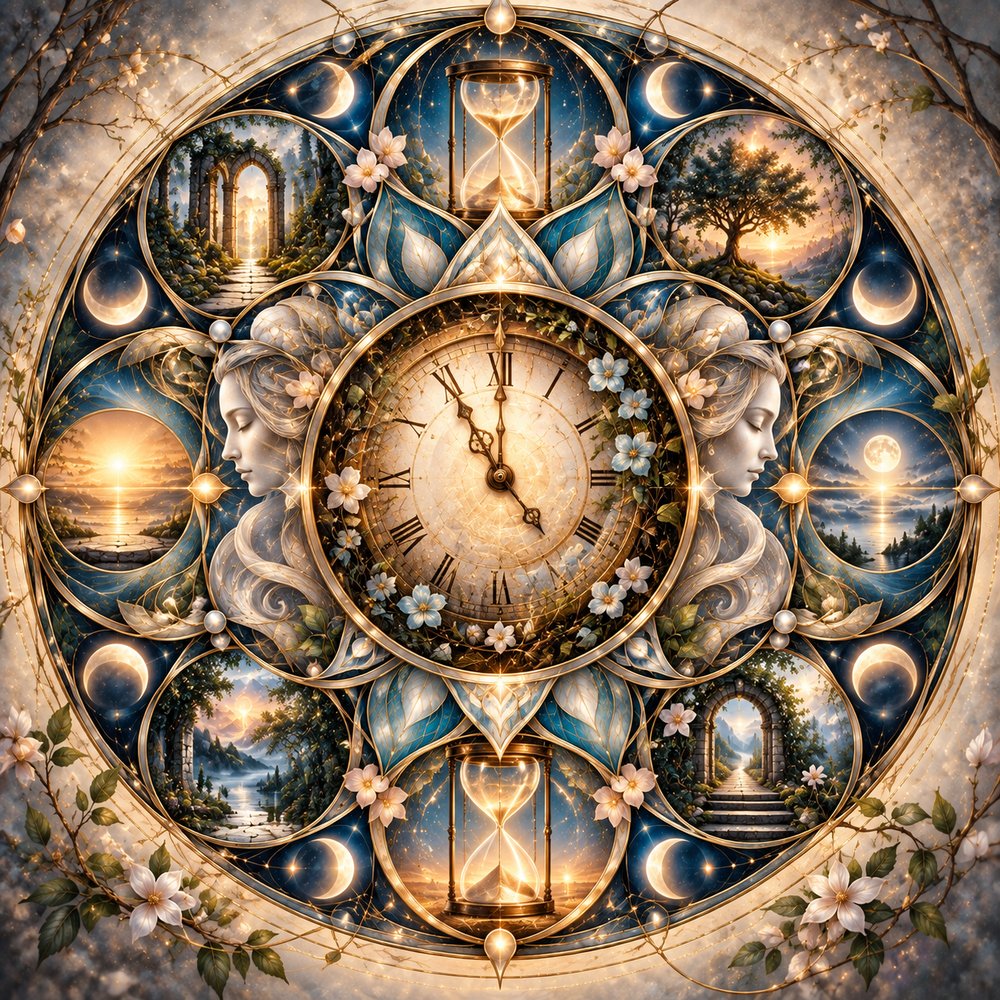
You have chosen the stopped clock. The hands have stayed at one hour, as though time has carried on everywhere else while one part of your story still keeps its own date. The Messenger of the Past comes when something that happened before carries on taking part in the way I live today. It may be a parting, a decision, a missed opportunity, a promise, a family story, a mistake, a success, a loss, or a period that ended long ago by the calendar but left a rule, an expectation or a conclusion behind it. The clock has stopped, I have carried on, and the old moment clearly still holds a staff pass to the present.
The rest of this article is for subscribers.
Open to everyone on .
The rest of this article is for subscribers.
Open to everyone on .